
The aosu SolarCam Pro system brings 2K solar-powered security cameras with encrypted local storage and no monthly fees. We set it up around the property to see how it holds up.
We put in a mesh network around the property a while back. That’s its own story. But one of the best things that came out of it was finally having reliable Wi-Fi reach the far corners of the land, which meant I could stop looking at security cameras that needed cloud subscriptions and start looking at something that worked over the local network instead. That’s how we ended up with the aosu SolarCam Pro system.
What It’s Built For
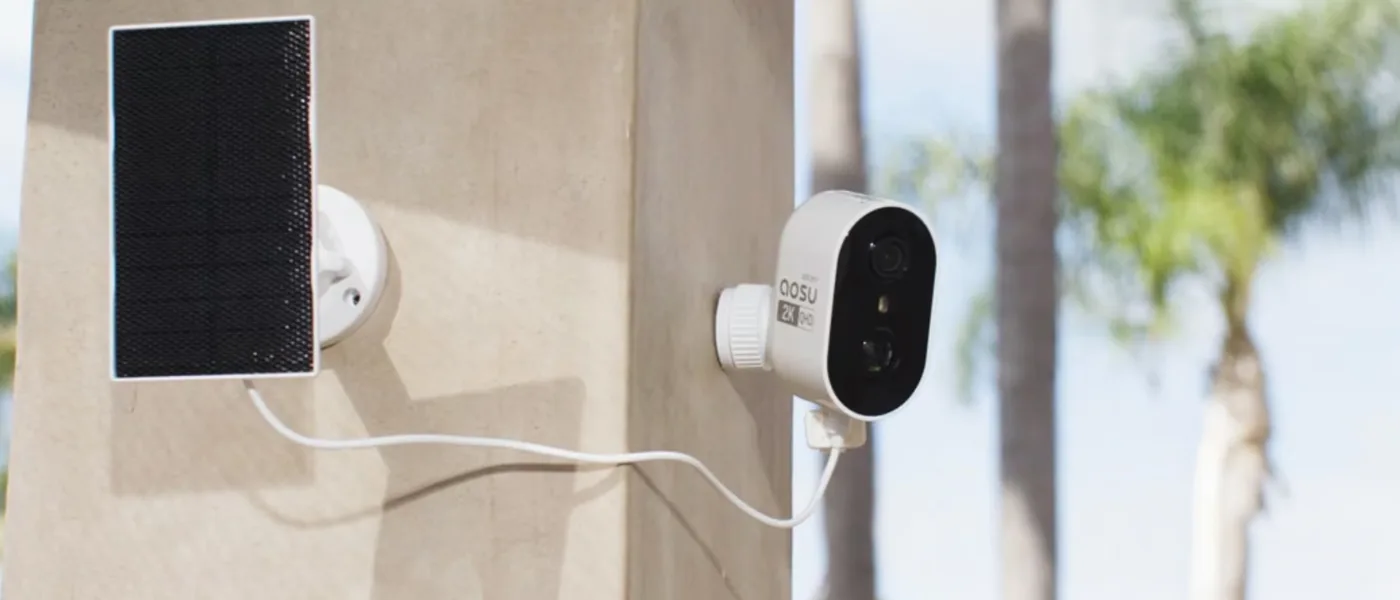
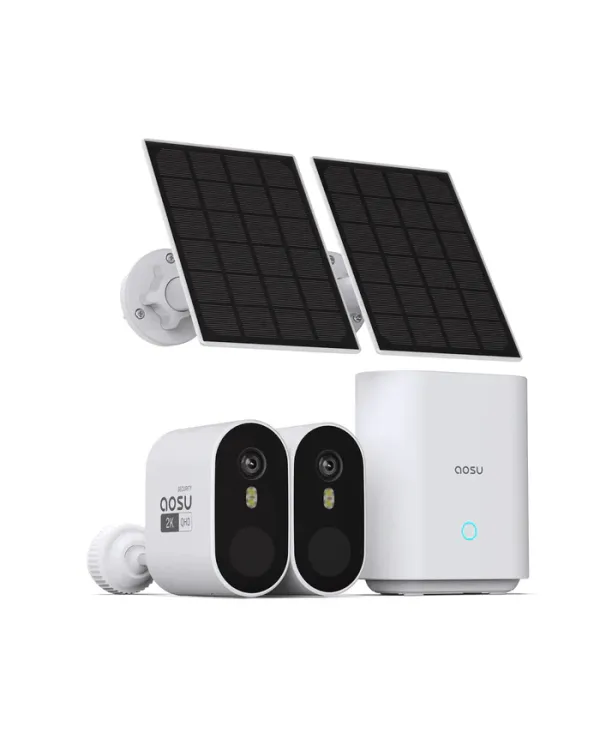
The SolarCam Pro is a wire-free outdoor security kit aimed at people who don’t want to pay a monthly fee just to see what happened outside their house. Each camera runs on a rechargeable battery topped off by a separate 1.5-watt solar panel you can aim independently from the camera itself. The footage goes to the aosuBase, a hub with 32 GB of encrypted local storage that connects to your home network over Ethernet. No cloud subscription needed to record motion events or pull up past clips.
The base system ships as a two-camera or four-camera kit, and you can buy add-on cameras later if you need more coverage. The cameras themselves are fixed wide-angle units with a 166-degree lens that covers serious ground from one mounting point. Resolution is 2K QHD, a visible step up from the 1080p you see on a lot of budget outdoor cameras. No mechanical pan or tilt here, just a wide, fixed view with 6x digital zoom if you need to get closer.
Design and Build
Build quality is about right for this price tier. The cameras are weather-sealed to IP66, which means they handle rain and dust without issue. I’ve had ours through some heavy downpours and a few freezing stretches, and they’re still running as long as the solar panels see daylight.
That separate solar panel setup is worth calling out. Most integrated-panel cameras force a compromise between where you point the lens and where you aim the panel. Here, you mount the camera wherever the view is best and run the panel a few feet away, aimed straight at the sun. It’s one of those design choices that seems obvious once you see it, especially if you’ve got a covered porch or a spot where the best camera angle doesn’t line up with good light.
The aosuBase is straightforward. A power input, an Ethernet port, and a sync button. Plug it into your router, pair the cameras through the app, and you’re set. It’s not glamorous, but it gets out of the way and does its job.
Performance in the Field
The live view is honestly the part I use most. Pulling up a camera at any time to check what the dogs are barking at, or see if the animals are where they’re supposed to be, that’s the kind of thing that sounds like a gimmick until you have it. The app lets you view up to four cameras at once, which covers the whole yard in one glance.
Image quality during the day is good. The 2K resolution and wide field of view mean you see more of what’s happening. Details like faces or vehicle activity are clear enough at reasonable distances. At night, the built-in spotlights switch on for full-color night vision, and there’s an IR path as well. You’re not getting 4K here, but for a solar-powered wireless camera at this price, the image holds up well.
Motion detection uses PIR plus AI person detection. It catches people reliably. Rain will trigger false alerts though. When water runs across the lens or a heavy downpour hits, you get notifications. It’s not a dealbreaker. You tune the sensitivity and move on. But these aren’t totally set-and-forget in wet weather, and that’s worth knowing going in.
Cold weather hasn’t been a problem as long as the panels get some sun. On overcast winter days when the solar barely trickles, the battery holds. If you hit a stretch of deep freeze with no sun at all, you’d probably need to USB charge the camera, but that hasn’t come up here.
Where It Falls Short
The app is the weak link. It works. You can view cameras, scroll through recorded clips, adjust settings. But it’s not as polished as Ring or Blink. Some users report occasional lag, and the interface takes a little getting used to. It’s functional, not pretty.
Storage is fixed at 32 GB. On the two-cam kit, that translates to a couple months of motion recordings. Run four cameras, and it drops to around sixty days. No way to expand it, and if you have a lot of motion events, your retention window shrinks. There’s an optional cloud plan if you want off-site backup, but for most people the local storage covers the basics.
The cameras are fixed wide-angle only. The 6x digital zoom in the app is just cropping and enlarging the sensor read, not optical zoom. If you need PTZ tracking or the ability to look around remotely, aosu’s D1 or T2 models are where you’d go instead.
Who Should Buy This
This system makes the most sense if you’re tired of monthly fees for outdoor cameras. The lack of a mandatory subscription and the included solar panels mean the kit price is essentially the whole cost. Compared to stringing Ring cameras around a property, you come out ahead inside the first year.
It’s also a strong pick if you actually use the live view. Checking on animals, seeing what the dogs are up to, keeping an eye on a big yard. The multi-cam live view makes that genuinely useful in a way that a single-camera setup doesn’t.
If you need a super polished app or expandable storage, this probably isn’t your first choice. And if you’re in a place with long, sunless winters, plan for occasional USB top-ups.
Bottom Line
The aosu SolarCam Pro delivers on the thing that made me look at it in the first place: good outdoor security without a monthly subscription. The video quality is solid for the price, the solar charging works when you get the panels placed right, and the live view is genuinely useful in a way I didn’t expect. The app could use some polish, and rain false alerts are real, but for the money especially compared to the multi-year subscription cost of a Ring setup this is a system that earns its spot around the property.